
Five Hectares in the Patagonian Steppe: The Lindero Atravesado Masterplan and the Architecture Vaca Muerta Demands

By Fernando Pérez Kaparunakis — ARIA Magazine, Insights

If you draw a line on a map of Argentina from the city of Neuquén northwest toward Añelo, past Lago Marí Menuco and into the Lindero Atravesado field, what you see is a route cutting through high desert. No shade, no water, no infrastructure. And yet, somewhere along that line stand some of the most sophisticated upstream operations in South America.
This is Vaca Muerta — Argentina's flagship shale play, located in the Neuquén Basin in northern Patagonia. It holds the world's second-largest shale gas reserves and fourth-largest shale oil reserves, and over the past decade it has become the engine of Argentina's energy strategy, attracting operators such as Pan American Energy, YPF, Shell, ExxonMobil, Chevron and TotalEnergies. For anyone who has worked in the Permian, the Bakken or the Eagle Ford, the operational logic is familiar. The geography is not.
This article is a walk-through of one of the projects that shaped my career as an architect: developing remote operational bases for Pan American Energy across the Neuquén basin, where modular construction stopped being an alternative and became the only reasonable answer to the problem.
The problem before the build
The Eastern Camp at Lindero Atravesado covers five hectares (about 12.4 acres) of operational footprint. Within that perimeter sit 344 m² (3,700 sq ft) of offices, a 230 m² (2,475 sq ft) dining hall, 168 m² of meeting rooms, a 110 m² entrance hall, parking and service areas, and a trailer compound for drilling operations and on-site medical services. Across Pan American Energy's full network in Neuquén, the numbers tell a more complete story: 134 distributed workstations, 4,670 m² of covered space, 23,464 m² of green areas, and at peak operation, 170 lunches served daily across bases that sit hours away from the nearest city.

The complexity is not in the square meters. It is in the logistics. Every bag of cement, every steel section, every wall panel costs time and fuel to reach the site. Every hour of skilled labor implies transport, accommodation, per diems, and an operational window dictated by the Patagonian climate, where winds regularly exceed 80 km/h and winter temperatures drop below freezing for months at a time. Conventional in-situ construction does not fail because it is impossible. It fails because it is inefficient. And in upstream operations where a day of delay can be measured in hundreds of thousands of dollars, inefficiency is the real adversary of any project.
Why modular — and why it isn't one single thing
The first clarification anyone working on remote camps owes their client: when we say "modular construction," we are not talking about one technology. At Lindero Atravesado we deployed several systems in parallel, each answering a different project question.

Custom-built transportable modules — a galvanized steel structural cage on a skid base, with interior and exterior cladding and either fiberglass, polyurethane or polystyrene insulation — solved the standardizable areas: offices, dormitories, ablution units. Their value lies not in how they look when finished, but in what they save along the way: factory-built under controlled conditions, with industrial tolerances, then delivered to site ready to be lifted, towed or rolled into final position.
Recycled marine containers brought something no traditional system can match: the ability to stack up to five levels using already-certified ISO structures, making higher-density camps possible when the site demands it. On projects such as the Valle Hermoso HUB, where 104 forty-foot modules were configured across two levels to house 600 workers, that stacking capacity changes the geometry of the problem entirely.
Steel frame entered where finish quality mattered without compromising speed. The industrialized galvanized-profile system allows for hybrid construction, integrated MEP, and complex volumetric resolution while keeping schedules tight. And for extreme uses — warehousing, maintenance shops, equipment shelters — Sprung-style structures with curved aluminum profiles and high-resistance membranes proved that you can cover wide spans in a matter of days.
The project decision was never which system to use. It was knowing when to use each one.
What the Eastern Camp taught us

The Eastern Camp ended up functioning as a reference masterplan. When the time came to design Bandurria, in the Aguada Pichana Oeste field, the brief was direct: scale the new development to the maximum projected needs of future areas, taking what we had learned at Lindero as the baseline. This sounds obvious in any other industry. In remote-base architecture it is a cultural shift. It means moving from one-off, irreproducible projects to a platform logic: a replicable system, with consolidated criteria for orientation, wind exposure, access and zoning, that allows the operator to scale with consistency.

Drone view of the Bandurria development. Shows how the Eastern Camp masterplan was replicated and scaled into a new field.
The site premises we applied at Aguada Pichana were straightforward: the closest possible access to the field's main entrance, a defined fiscal zone, high ground for sightlines and orientation, and always — always — careful reading of the Patagonian wind. Details that look minor on a plan and that, in daily operation, decide whether a dining hall is bearable in August or whether an office becomes a resonance chamber every time the wind blows from the west.
Beyond the module: what a camp must be
There is a common mistake in any conversation about modular construction: thinking of it only as a logistics solution. It is — but it is also something more. A remote camp is, for three weeks of every month, the home of hundreds of people who are far from theirs. Spatial quality is not a luxury here. It is part of operational performance. Daylight in a dining hall, ceiling height in a meeting room, the transition between freezing exterior and a properly resolved entrance — these are not aesthetic concerns. They are variables that affect fatigue, team morale and, ultimately, the productivity of the field.
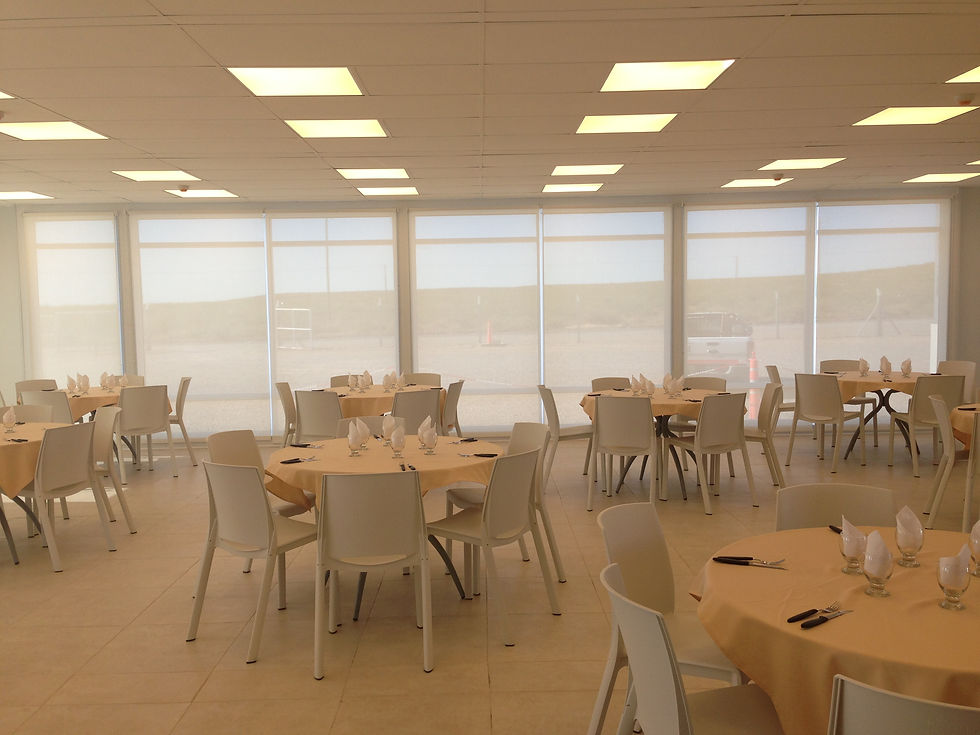
That is why the 230 m² dining hall at Lindero Atravesado was designed with full-height glazing oriented to capture natural light without turning the space into an oven. That is why the 110 m² entrance hall functions as both a climatic filter and a gathering space. That is why the office sector was separated from the trailer compound, securing privacy without losing operational connectivity. Modularity is not the enemy of architectural craft. It is its partner — if you know how to direct it.
The takeaway
After years working on remote bases across the Neuquén basin, the Patagonian Atlantic coast, and the San Jorge Gulf, I am convinced of one thing: modular construction is not the cheap option, the fast option, or the temporary option. It is the intelligent option, when context demands it. It is the only approach that lets you deliver five hectares of operational camp with architectural quality on schedules compatible with Vaca Muerta's velocity.
The real challenge for the architect on this kind of project is not solving the module. The industry solves the module. The challenge is directing a system — knowing when to stack containers, when to switch to steel frame, when to lift a custom module, how to orient them, how to connect them, how to give them architectural dignity — so that the final result is, beyond efficient, a good place to work and live.
That, in the end, is what defines a complex project well done. Not the technical difficulty. The capacity to make that difficulty invisible.
_________________________________________________________________________
Fernando Pérez Kaparunakis is an architect specialized in complex architecture projects, with a focus on remote bases and industrialized construction for the energy industry. He has led projects for Pan American Energy, Axion and other operators across Argentina's Vaca Muerta and the San Jorge Gulf basin.

Comentarios